




Peptic Ulcers
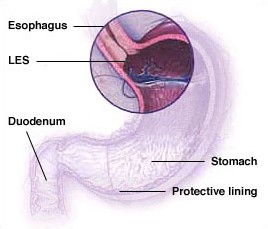
Normal esophagus.
Image courtesy AstraZeneca LP
Your stomach contains acid that helps you to dissolve food. Without it, your digestive system can't work properly. But too much acid can cause several acid-related disease and disorders, like gastroesophageal reflux disease (GERD), dyspepsia, and peptic ulcers.
We'll be explaining what ulcers are. But before we explain these diseases, let's look at how the stomach works:
The esophagus is the hollow tube that connects the mouth to the stomach. The lower esophageal sphincter (LES) is a muscle, shaped like a ring, that opens to allow food to enter the stomach and also prevents acid from backing up into the esophagus.
Food is broken down and digested in the stomach. The duodenum is connected to the stomach and goes to the small intestine where nutrients are absorbed.
When food is eaten, it goes down the esophagus, through the LES and into your stomach. The stomach produces acid, which breaks down the food. The LES closes tightly after food has passed protecting your esophagus from the acid.
Normal acid function in your digestive system depends on acid remaining in your stomach and the stomach's lining staying intact.
What are ulcers?
A peptic ulcer is a sore in the lining of your stomach or duodenum. The duodenum is the first part of your small intestine. If peptic ulcers are found in the stomach, they're called gastric ulcers. If they're found in the duodenum, they're called duodenal ulcers. You can have more than one ulcer.Many people have peptic ulcers. Peptic ulcers can be treated successfully. Seeing your doctor is the first step.
What are the symptoms of ulcers?
A burning pain in the gut is the most common symptom. The pain:- feels like a dull ache
- comes and goes for a few days or weeks
- starts 2 to 3 hours after a meal
- comes in the middle of the night when your stomach is empty
- usually goes away after you eat
Other symptoms include:
- losing weight
- not feeling like eating
- having pain while eating
- feeling sick to your stomach
- vomiting
Some people with peptic ulcers have mild symptoms. If you have any of these symptoms, you may have a peptic ulcer and should see your doctor.
What causes ulcers?
Peptic ulcers are caused by:- bacteria called Helicobacter pylori (H. pylori for short)
- nonsteroidal anti-inflammatory drugs (NSAIDs) such as aspirin and ibuprofen
- other diseases
Your body makes strong acids that digest food. A lining protects the inside of your stomach and duodenum from these acids. If the lining breaks down, the acids can damage the walls.
Both H. pylori and NSAIDs weaken the lining so acid can reach the stomach or duodenal wall. H. pylori causes almost two-thirds of all ulcers. Many people have H. pylori infections. But not everyone who has an infection will develop a peptic ulcer.
Most other ulcers are caused by NSAIDs. Only rarely do other diseases cause ulcers.
Do stress or spicy foods cause ulcers?
No, neither stress nor spicy foods cause ulcers. But they can make ulcers worse. Drinking alcohol or smoking can make ulcers worse, too.What increases my risk of getting ulcers?
You're more likely to develop a peptic ulcer if you:- have an H. pylori infection
- use NSAIDs often
- smoke cigarettes
- drink alcohol
- have relatives who have peptic ulcers
- are 50 years old or older
Can ulcers get worse?
Peptic ulcers will get worse if they aren't treated. Call your doctor right away if you have any of these symptoms:- sudden sharp pain that doesn't go away
- black or bloody stools
- bloody vomit or vomit that looks like coffee grounds
These could be signs that:
- the ulcer has gone through, or perforated, the stomach or duodenal wall
- the ulcer has broken a blood vessel
- the ulcer has stopped food from moving from the stomach into the duodenum
These symptoms must be treated quickly. You may need surgery.
How can I find out if I have ulcers?
If you have symptoms, see your doctor. Your doctor may take x-rays of your stomach and duodenum, called an upper GI series. You'll drink a liquid called barium to make your stomach and duodenum show up clearly on the x-rays.Your doctor may also use a thin lighted tube with a tiny camera on the end to look at the inside of your stomach and duodenum. This procedure is called an endoscopy. You'll take some medicine to relax you so your doctor can pass the thin tube through your mouth to your stomach and duodenum. Your doctor may also remove a tiny piece of your stomach to view under a microscope. This procedure is called a biopsy.
If you do have a peptic ulcer, your doctor may test your breath, blood, or tissue to see whether bacteria caused the ulcer.
How are ulcers treated?
Peptic ulcers can be cured. Medicines for peptic ulcers include proton pump inhibitors or histamine receptor blockers to stop your stomach from making acids, or antibiotics to kill the bacteria. Depending on your symptoms, you may take one or more of these medicines for a few weeks. They'll stop the pain and help heal your stomach or duodenum.Ulcers take time to heal. Take your medicines even if the pain goes away. If these medicines make you feel sick or dizzy, or cause diarrhea or headaches, your doctor can change your medicines.
If NSAIDs caused your peptic ulcer, you'll need to stop taking them. If you smoke, quit. Smoking slows healing of ulcers.
Can ulcers come back?
Yes. If you stop taking your antibiotic too soon, not all the bacteria will be gone and not all the sores will be healed. If you still smoke or take NSAIDs, your ulcers may come back.What happens if ulcers don't heal? Will I need surgery?
In many cases, medicine heals ulcers. You may need surgery if your ulcers don't heal, keep coming back, or perforate, bleed, or obstruct the stomach or duodenum. Surgery can remove the ulcers or reduce the amount of acid your stomach makes.What can I do to prevent and lower my risk for getting ulcers?
Stop using NSAIDs; talk with your doctor about other pain relievers. Also, don't smoke and don't drink alcohol.If you have any questions or wish to schedule an appointment, please do not hesitate to call the office at (706) 548-0058. Remember that we usually require that you see a primary care physician (your family doctor or PCP) before we can schedule you. If you are having a medical emergency, get medical attention immediately at your nearest healthcare provider:
Athens Regional Medical Center: (706) 475-7000
St. Mary's Hospital: (706) 354-3000
This informational material is taken from resources by AstraZeneca LP and Caremark, Inc., as well as the National Digestive Diseases Information Clearinghouse, a division of the U.S. Department of Health and Human Services.
Please see the Contact Us page for street maps.
Click here to
Request an Appointment.